

OK, maybe it's not quite that simple.
PRETTY POISON, directed by Noel Black, is a true gem of a cult movie. It's one of those quiet, slow starting films that seems to be heading in a sure direction, but suddenly takes a sharp turn, giving the viewer one surprise after another. The screenplay, by Lorenzo Semple, Jr., is based on the novel She Let Him Continue by Stephen Geller.
At the beginning of the film, Dennis Pitt (Anthony Perkins) is being released on parole from a mental institution. He was sent there at the age of fifteen for setting fire to a house and killing his aunt. Dennis claimed he didn't know she was in the house. His parole officer, Morton Azenauer (John Randolph), has found a job for Dennis. One of Dennis' problems is that he creates fantasies in his mind that he believes are real. Mr. Azenauer warns Dennis that he needs to control his thoughts so they don't get out of control.

When we next see Dennis, he has left the job the parole officer found for him and has moved on to a different town without letting the officer know. He works in a chemical plant. Dennis is concerned about the toxic waste the plant is pouring into a river that runs next to the plant. He sees the brightly colored chemicals, the "pretty poison", being discharged into the water and wants to do something about it. One day he's watching a local high school band practice their marching routine and he notices a beautiful blonde girl carrying the American flag. He meets this same girl at an outdoor hamburger stand where he eats lunch every day. Her name is Sue Ann Stepanek (Tuesday Weld). They begin talking and Dennis is immediately attracted to the teenager. Sue Ann complains about her strict mother (Beverly Garland). Dennis tells Sue Ann that he's a government agent on a secret mission that concerns the pollution at the chemical plant. It isn't clear whether or not Dennis is once again experiencing a delusion or if he just wants to impress Sue Ann by pretending to be something he's not. Whatever the case, the seemingly innocent girl believes his story and wants to be a part of his secret mission. As Dennis becomes more smitten with Sue Ann, he soon learns that there is another kind of "pretty poison" at work in this small town.
 |
| The film's introduction to Sue Ann Stepanek (Tuesday Weld). |
The career of Anthony Perkins was so affected by his brilliant performance as Norman Bates in PSYCHO that he never escaped that image of a mentally unstable man who always seemed on the verge of a breakdown. PRETTY POISON was actually his first American film since the Hitchcock classic, and it's tempting to see Dennis Pitt as another incarnation of Norman Bates, being released from an asylum several years after his murder spree in the earlier film. His performance here is excellent, full of tension, and with all of the nervous ticks and voice inflections that became his trademarks. Equally impressive is gorgeous Tuesday Weld. The twenty-four year old actress may have been too old to play a high school girl, but she is completely believable as Sue Ann. Miss Weld had been acting since the late 1950's, often in inconsequential comedies. Occasionally she was given a chance to show her abilities in more serious roles such as in SOLDIER IN THE RAIN (1962), WILD IN THE COUNTRY (1961), and THE CINCINNATI KID (1965). She also proved herself adept at black comedy in another cult film called LORD LOVE A DUCK (1966).
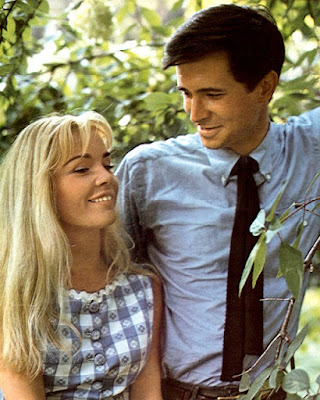
Despite her excellent performance, Tuesday Weld was unhappy with the film, mainly because she disliked the director. As a result, she refused to do anything to promote PRETTY POISON, and the film was released to theaters with little fanfare and disappeared very quickly. In subsequent years, especially after the advent of home video, the film has become more popular with fans and critics. Strangely enough, it has been described as a black comedy. To me, that's a ridiculous way to classify it, as there is nothing comical going on in the story. One of the fascinating things about the film is that it has the look and tone of a TV movie of the week. I don't know if this is what the director intended, but the somewhat laid back quality of the opening sequences only add to the visceral punch in the gut that comes when the narrative suddenly leads to darkness and violence.
Beverly Garland, another talented, underrated actress in films and television, has one of the best roles of her career as Sue Ann's mother. Her interactions with Weld and Perkins are some of the most memorable scenes in the film. Also on hand is the brilliant character actor John Randolph, who was so unforgettable in SECONDS (1966). Also in the cast are Dick O'Neil, Clarice Blackburn, Joseph Bova, Ken Kercheval, and Don Fellows.
 |
| The talented Beverly Garland in one of her standout roles. |
 |
| Anthony Perkins and John Randolph |
The film received mixed critical response and failed financially. Still, Lorenzo Semple, Jr. was given the New York Film Critics Circle Award for Best Screenplay in 1968. Tuesday Weld and Anthony Perkins would reunite for PLAY IT AS IT LAYS in 1972. Noel Black continued to work in feature films and television with different degrees of success: JENNIFER ON MY MIND (1971), A MAN, A WOMAN, AND A BANK (1979), PRIVATE SCHOOL (1983), and a 1985 TV movie called PROMISES TO KEEP, starring Robert Mitchum.


