FILM REVIEWS, COLLECTION UPDATES, COMMENTS ON CINEMATIC CULTURE

Friday, June 25, 2021

THE SUMMER OF LOVE: HOW HIPPIES CHANGED THE WORLD (2017)


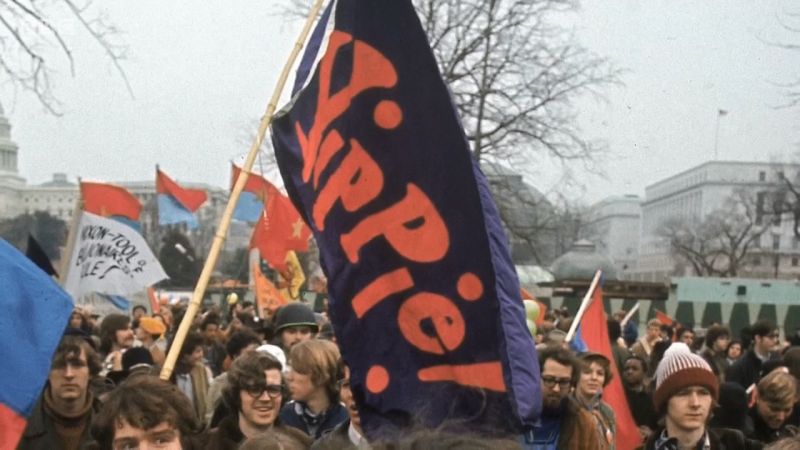
In 1977, ten years after the fabled Summer of Love, I made my first pilgrimage to Haight-Ashbury in San Francisco. I was twenty-six years old, a confirmed, card-carrying member of the Baby Boom generation, someone who had come of age during that most insane of all decades: the 1960's. There is no way in the world I could have claimed to be a hippie. Not even close. And yet, even those of us who lived in the exiles of the Midwestern fly-over states were affected by the West Coast cultural movement; certainly the music, but also the fashions, and the political ideologies. Free love? Well, not so much. At least, for most of us. Drug use? That crept in later, during the 1970's. Life moves at a much slower pace in small town Illinois. A lot of us guys tried growing our hair long in high school, much to the dismay of our conservative parents. Myself, I managed to grow my hair as long as a modified Beatle look. With my stern father fighting me every step (and every strand) of the way, that's as far as it got. My own, personal hippie-esque countercultural phase didn't begin in earnest until I was nineteen years old and living on my own, away from the parental gaze. 

San Francisco seemed like some mythical paradise that may not actually exist, but was rather the embodiment of a collective fantasy for those of us living in the flatlands, with no mountains or ocean views, and no colorful Victorian houses built on steep hills with cable cars running up and down the streets. I somehow expected to find Haight-Ashbury exactly like it had been shown to us on old TV shows, nightly newscasts, and in movies like PSYCH-OUT (1968). Of course, the reality was quite different. Not necessarily disappointing, but different. The city was every bit as beautiful as I had imagined. And Haight Street still had some countercultural landmarks that gave me the nostalgic vibe I was longing for. But it was also an area that was undergoing transformation and gentrification. There were plenty of quirky bars,  restaurants and shops to be found. And some of them were quite expensive. Some of the hippies had obviously incorporated and decided capitalism wasn't such a bad idea after all. I spent a fair amount of time wandering around the neighborhood, talked to a lot of people, and soaked up the atmosphere. It was my own version of the Summer of Love, ten years after the fact.

There have been many documentaries about that mythical summer of 1967. All of them show pretty much the same images, use the popular music of the time, and feature comments from many of the people who lived in that area and experienced it all first hand. This 2017 documentary from the BBC goes a little bit deeper than most of the others that I've seen over the years. The copy I have is from The Video Beat, and is a very good DVD-R print.


The documentary, narrated by Gina McKee, examines the roots of the hippie movement from three different perspectives: 

1. The Nature Boys

2. The Truth Seekers

3. The Politicals

 The Nature Boy movement goes back to the early twentieth century and a number of young men who dropped out of society and lived in the woods, eating natural foods and trying to live in harmony with the earth. One of the later followers of this movement, a man named  Eden Abez, wrote a song called Nature Boy in 1951, a song made popular by Nat King Cole. Other followers would eventually relocate to San Francisco and open up one of the first health food stores. Their influence, combined with the Beat movement, evolved into what would later become part of the hippie counterculture.

The Truth Seekers were influenced by writers and artists such as Alastair Crowley, the British proponent of Eastern Mysticism, and later occultism, Aldous Huxley, the author of a book entitled The Doors of Perception, and others who promoted the experimentation with the drug LSD. This drug had been around since 1938, and was being used by the American military establishment in experiments with the goal of using it against our enemies. The drug was still legal in the early 1960's and was becoming popular among intellectuals and young people. This growing interest in LSD, along with the widespread use of marijuana, became one of the most important behavioral shifts of the San Francisco scene. Several people interviewed for the documentary talk about their mystical experiences from taking acid. One of them is Eric Burden, the lead singer of The Animals. There are also quotes from Ken Kesey, the author of One Flew Over The Cuckoo's Nest, who was given the drug by the CIA. And there was an surprising bit of information about actor Cary Grant, who apparently took over 100 acid trips. 

The Political movement began largely at the nearby Berkeley campus of the University of California, the acknowledged birthplace of the radical, Marxist thought, spearheaded by professors like Herbert Marcuse. This growing movement led to the formation of groups like Students For a Democratic Society and its even more radical offshoot, the Weather Underground. Also born from these roots were the Black Panthers and the Women's Liberation organizations. 

These three cultural components somehow began to merge in the hills of San Francisco and came together in a public celebration called The Human Be-In, A Gathering of the Tribes, held in Golden Gate Park in January, 1967. It was a celebration of music, drugs, free love, etc. As the months went on, the Haight-Ashbury neighborhood, once a community of like minded, peace loving folks, became a nightmare of runaway teenagers and increasing use of harder drugs. The Summer of Love ended with the public demonstration of the Death of the Hippie organized by The Diggers, a group of folks who operated a free store and tried to support the community in any way they could. 

The documentary uses interviews and comments from many of the people who lived in the Haigh during those times. We hear from Peter Coyote, one of the founders of The Diggers, Country Joe McDonald, one of the prominent musicians of the period, Graham Nash, Mickey Dolenz, Peter Lewis of the rock group Moby Grape, Stewart Brand, founder of The Whole Earth Catalog, and Jorma Kaukonen of Jefferson Airplane. We also hear from some of the political figures of the period, such as Bernadine Dohrn of the Weather Underground and Elaine Brown, former president of The Black Panthers.


As the documentary shows, the hippie experiment failed in most of its political efforts, but it still had profound influences in areas such as sexual mores and the New Age/Human Potential movements. It also discusses the connection between the 60's search for expanding consciousness and the electronic communication revolution. It speaks of the Internet Communes and the Interlinked Consciousness, largely brought into being by that very well known ex-hippie, Steve Jobs.

This film is an informative and enjoyable watch, not only for us Boomers, but for anyone wanting to learn about this fascinating time in human history. For me, having evolved into a much more conservative mode of living and thinking, the Summer of Love and everything it used to mean is mostly just another part of my lost youth that is fun to remember and even celebrate. What remains important for me will always be the music. That will never go out of style. Forget the politics. Most of those people were crazy. And forget the drugs. I may have smoked my share of grass in my 20's, but nothing ever made me consider LSD as a viable lifestyle choice. Thank God. But the music? Jefferson Airplane, Big Brother And The Holding Company, Janis and Jimi, they still speak to my heart. Even though the Summer is over and gone.


Sunday, June 20, 2021

A JOAN CRAWFORD TRIPLE FEATURE


OUR DANCING DAUGHTERS (1928)

Joan Crawford achieved major stardom with her portrayal of "Dangerous" Diana Medford, the wild Jazz Age flapper with the decent, honest heart, in this silent classic. Miss Crawford's dancing may not hold up very well for some modern viewers, but she gives a solid dramatic performance, dressed in high fashion and living in an Art Deco fantasy world. The film was made during the last days of the silents and has a musical soundtrack that includes a few lines of spoken dialogue. The acting style is more sophisticated with very little of the exaggerated gestures and eye rolling of previous years. Miss Crawford proves she is more than ready to enter the sound era. The Joan Crawford screen image here is different than the one she would project a few years down the road, with the large eyebrows and the full, sensuous lips. But the talent, as well as the energy and warmth, that would carry her into a brilliant, long lasting film career, are obviously present. And she is a pleasure to behold.

Excellent performances are also given by John Mack Brown, Nils Asther, Dorothy Sebastian and Anita Page.


THE GORGEOUS HUSSY (1936)

This handsomely mounted MGM production, directed by Clarence Brown, is a work of historical fiction, starring Miss Joan Crawford. She plays a character named Peggy O'Neal Eaton, an often maligned, misunderstood confidante of President Andrew Jackson (Lionel Barrymore). The movie shows Peggy's humble beginnings as the daughter of a simple, honest innkeeper, and her emergence into political society following her first marriage to a naval officer.

The story, however, is of secondary importance to the fact that this is a Joan Crawford Picture. As such, it is necessary for Miss Crawford to occupy the center stage throughout and be allowed to display the usual, and expected, gamut of Crawfordesque emotions and situations. These include, but are by no means limited to, rising above her social standing, experiencing the thrill of romance (In this area she is assisted by such physically appropriate leading men as Melvyn Douglas, Robert Taylor, Franchot Tone and James Stewart.), and valiantly standing up to those folks who look down on her as trash. To achieve these cinematic ends, Miss Crawford is to be featured in frequent facial closeups, bathed in celestial light, enabling her adoring audience to gaze reverently at her perfect bone structure. 

Also featuring Beulah Bondi, who was nominated for an Academy Award for Best Supporting Actress. The film also received a nomination for Best Cinematography.

Robert Taylor and Joan Crawford


AUTUMN LEAVES (1956)

Joan Crawford stars as Millicent Wetherby, a middle aged writer whose sexual deprivation has practically reached toxic levels. She meets a handsome younger man named Bert Hansen (Cliff Robertson), and, against her better judgement, falls in love with him and gets married. Their domestic bliss comes to a screeching halt when she discovers her new husband is mentally ill. Figuring into the somewhat sordid plot are Bert's father (Lorne Green) and ex-wife (Vera Miles). This totally enjoyable romantic/psychological drama gives Miss Crawford many opportunities to suffer with great nobility. Robert Aldrich directed. Six years later, Aldrich and Crawford would work together again on the classic WHATEVER HAPPENED TO BABY JANE?, in which her quota of suffering would increase considerably. 

Also featuring Ruth Donnelly, Sheppard Strudwick, Marjorie Bennett and Maxine Cooper. Nat King Cole sings the beautiful theme song during the opening credits.


Tuesday, May 18, 2021

BOOK REVIEW: SHOOTING MIDNIGHT COWBOY by GLENN FRANKEL (2021)

Glenn Frankel has written an exhaustive, and somewhat exhausting, account of the making of the classic film MIDNIGHT COWBOY (1969). To give an idea of just how exhaustive the book is, the author doesn't get to the actual film set until the fifteenth chapter, the middle of the book. Before we get there, Frankel takes us on a long path of preparation by detailing the lives of all the key players in the film's history. He begins with James Leo Herlihy, who wrote the novel that was published in 1965. We learn about his working class upbringing in the Midwest, his struggles to be established as a writer, and his coming to terms with his gay sexuality. Frankel continues with similar background stories of director James Schlesinger, screenwriter Waldo Salt, the producers, casting director, and many other members of the film crew. Eventually we learn how stars Dustin Hoffman and Jon Voight got involved, as well as other members of the cast. One of the best things about the book, as in other books of this kind, is the inclusion of quotes from the actors and actresses involved. We learn quite a bit about the relationship between Hoffman and Voight and how they worked together. Jennifer Salt, who had a supporting role in the film, is quoted throughout concerning her father, Waldo Salt, and her romantic connection to Voight during the film's production. Frankel also gives us a lot of insight into New York City, its unique culture, and its importance to the film. 


I read the novel in 1968 when I was seventeen. It's impossible to remember a lot of details of the story. But I do remember going to see the film during its initial release and being disappointed by the way the story was portrayed on the screen. I guess my image of Joe Buck was much different than the way Mr. Voight played him. With subsequent viewings of the film, my feelings changed. I was able to appreciate the film for itself and see its many outstanding qualities rather than comparing it to the superiority of the novel. While reading Frankel's book, I watched the film again. I even considered finding a copy of the novel and rereading it. But by the end of SHOOTING MIDNIGHT COWBOY, I found myself a little overwhelmed by the sad lives of Joe Buck, Rico Rizzo, and their creator, James Leo Herlihy. I think I've had quite enough of MIDNIGHT COWBOY and the mean, lonely streets of New York City. At least for a while. That said, this book is essential reading for fans of the movie. Just realize that you'll probably need some cheering up after you've finished reading it.


Monday, May 17, 2021

TORMENTED (2011)


I originally wrote this review in 2016 for a "zine" called HARA-KIRI: EXTREME ASIAN FILMS. The zine was a project masterminded by my good friend Dave Koenig, known to his friends and fans on Youtube and Facebook as A Fiend On Film. Dave is a guy filled with creative energy who has published other one-shot zines, some of which I have been privileged to participate in. I was honored when Dave asked me to take part in this project as well.

It must be said at the outset that one man's Extreme Asian Cinema is another man's Julie Andrews Film Festival. As someone who tends to avoid films loaded down with graphic violence and buckets of (hopefully fake) blood, my concept of "extreme" is no doubt quite different than someone with a higher tolerance for the glories of gore. That certainly proved to be true when I read some of the other reviews included in this zine! However, in the last several years, I've begun to appreciate horror films from Japan, such as Takashi Shimizu's JU-ON aka THE GRUDGE, and Kiyoshi Kurosawa's KAIRO aka PULSE. Although these films contain a certain amount of violence, they tend to rely more on mood, atmosphere and dark imagery to provide viewers with chills and thrills. With his 2011 3D release TORMENTED, Shimizu continues his legacy with a dark mystery that  has children as the central characters.

The story concerns Kiriko (Hikari Mitsushima), a young girl who lives with her father, Kohei (Teruyuki Kagawa), and her little half-brother, Daigo (Takeru Shibuya). Kohei is a creator of pop-up books for children. Kiriko has suffered some sort of trauma that has left her unable to speak. She is very protective toward Daigo and is worried about his behavior. Daigo killed a rabbit that was being raised by the children at their school. Kohei seems too preoccupied to share Kiriko's concern for her brother. One night, Kiriko takes Daigo to see the 3D horror movie THE SHOCK LABYRINTH, and a stuffed rabbit comes out of the screen and into Daigo's arms. Daigo begins having strange dreams where he is taken to an amusement park by a giant rabbit. At first, the rabbit is friendly and they have fun at the park. But soon the rabbit's appearance changes, becoming menacing and threatening. The rabbit leads Daigo into an abandoned hospital where he sees a vision of a woman bleeding and dying on a gurney.

Kiriko tries desperately to communicate with her father about Daigo's nightmares. Her father reacts in anger and tells her to stop her delusions. After this, Kiriko begins to remember events that she had repressed. A few years ago, her father brought home a new wife, Kyoko, who was very pregnant. Kiriko was unable to accept her new stepmother and became increasingly angry and agitated. One day her father took her to an amusement park. While riding on the carousel, she was surprised by Kyoko, dressed up as a giant rabbit. Kyoko gave her stepdaughter a stuffed rabbit as a gift. Kiriko pushed Kyoko off of the carousel, causing her to go into premature labor. At a nearby hospital, Kyoko died, along with her infant son. Kiriko, in her guilt and grief, had imagined that the baby had lived. Daigo was a creation of her delusional mind. It was she who was having the nightmares, and she who killed the rabbit at her school. She has been living in terror of Kyoko coming back from the dead for revenge.

Hikari Mitsushima

In spite of regaining her memory, Kiriko continues to see and interact with Daigo. One day he leads her to the abandoned hospital where Kyoko and her baby died. Daigo stabs Kiriko and pushes her down a stairwell to her death. At the film's end, Kohei is seen walking hand in hand with his little son, Daigo.

This film is graced with an outstanding performance by actress Hikari Mitsushima, and the other actors are also very talented, making the surreal, somewhat convoluted plot believable. There is such a palpable feeling of sadness and dread throughout the film, and it rarely lets up. Also worth mentioning are the cinematography and the set designs. Our first look at the amusement park in Daigo's dream is a vision of dazzling beauty, which is soon replaced by a vision of unrelenting darkness, and an apprehension of danger waiting for the child. Shimizu uses scenes from his own film THE SHOCK LABYRINTH as the movie-within-the-movie. No doubt the giant rabbit will call to mind the image of Frank the rabbit in DONNIE DARKO. The Darko Cult members will have to decide for themselves which cinematic hare is more disturbing.

Violence is minimal in TORMENTED. But the shocking death of Kiriko is, in my opinion, worthy of the term "extreme". Many horror fans would probably disagree. In any case, the film is worth seeing. You will be haunted by its imagery, and by the marvelous acting of Hikari Mitsushima.

Thursday, May 6, 2021

THE PARTY CRASHERS (1958)


Anyone familiar with this blog and my Youtube channel knows that I have a fanatical fixation with teenage oriented movies from the mid-1950's to the mid-1960's. My friends and fellow DVD collectors on Youtube, who don't share my fixation, have given these films the label "teen angst flicks", a label I have happily adopted for my own usage. While most film fans can recognize the merits of serious, innovative classics like BLACKBOARD JUNGLE and REBEL WITHOUT A CAUSE, both big studio productions released in 1955, not everyone is as thrilled as I am with lower budget exploitational titles such as HIGH SCHOOL CONFIDENTIAL and JUVENILE JUNGLE, both released in 1958. And film scholars who show reverence for James Dean and Natalie Wood are usually more dismissive towards lesser known talents like Scott Marlowe and Yvonne Lime. 

Me? I love them all. Low budget, big budget, it doesn't matter. There is something magical for me about these movies that took hold of my imagination way back in the 1960's and 1970's when so many of them played over and over on television. No doubt it has to do with the general themes of rebelliousness, loneliness, sexual awakening and alienation from parents that can be understood by every young person in every era. But for me, it also reflects a fascination for an era that existed before I entered my own teen years in 1964. The early days of rock 'n roll, the malt shops, the leather jackets and the D.A. haircuts worn by the boys in those movies were all part of the culture of the generation before me. I guess every kid pays close attention to what the older kids are doing and tries to imitate them as much as possible. That teen angst passes like a virus from one generation to the next, and gets updated and modified accordingly.

As more and more of these teen oriented films came out, the plots expanded to include dragstrip dramas, adventures in reform schools, teenage werewolves and endless variations on the dangers of premarital sex. Some of the movies featured comedy and music, and some were trying to be deadly serious. And usually the parents and other adults (teachers, police) were portrayed as the enemies or simply clueless obstacles to the kids and their longing for freedom and excitement. Adults tended to be portrayed as one dimensional characters. But every once in a while there was a film that stood out for its exploration of a slightly darker side of family relationships. One such film was THE PARTY CRASHERS, a Paramount picture released in 1958. Because of its rather lame title, one might expect nothing more than the usual exploitational atmosphere. This film, however, has a little bit more to offer.

The film begins with a teenage party in a private home being crashed by a local bad guy, Twig Webster (Mark Damon) and his unruly pals. The party quickly devolves into a brawl and someone calls the cops. Most everyone manages to get away before the cops arrive. Barbara Nickerson (Connie Stevens) and her boyfriend Josh Bickford (Robert Driscoll) were at the party. Barbara had gotten bored and told Josh she wanted to leave. But when Twig and his gang arrived, she was intrigued and decided to stay. Barbara is turned on by Twig and his reckless attitude. She tells Josh: "He's like an animal." Josh is appalled by Twig's behavior and upset by Barbara's attitude. Josh goes home to his obviously caring parents (Frances Farmer and Denver Pyle). Twig, however, goes home to find his father (Walter Brooke) drunk and complaining that his mother has been out all night, supposedly seeing a movie with a girlfriend. Twig's home life is established as unhappy and chaotic. His mother (Doris Dowling) comes home and has an argument with her husband, berating him in front of their son. She even physically assaults her husband when he accuses her of being a tramp. She seductively stands close to Twig and demands that he kiss her.

Mark "He's like an animal!!" Damon


The next day, Josh goes to Barbara's house to find that her father (Onslow Stevens) knows all about the party and has invited Twig over to encourage friendship between the two boys. Josh is not happy. But he agrees to take Barbara to a club called The Shack at Twig's suggestion. Twig stops at his house to ask his father for extra money. His mother has gone out again and his father is drunk. He and his father argue. His father threatens to sell his son's car if he crashes another party. He tells Twig about a big party that will be taking place at a local motel. Twig doesn't know anything about the party. He also doesn't know that Mr. Webster suspects his wife will be there and is secretly encouraging his son to go there and find her.

Twig talks Barbara, Josh, and a few of their friends into crashing the party, just so he can spite his father. When they get there, they find out it isn't a teenager's party, but one attended by adults the same age as their parents. The drunken partygoers refuse to let the kids leave, locking the door. The grown men go after the young girls while the grown women go after the young boys. The kids are appalled and embarrassed and want to get out. Josh starts a fight with one of the men that turns into a brawl, while Twig goes to look for a back door from which they can escape. He sees a man coming out of a bedroom with his shirt unbuttoned. He goes into the room and finds his mother sitting next to an unmade bed. He tries to get her to leave, but she refuses. In a struggle, she falls down a flight of stairs and is seriously injured. Twig runs away when the police show up. He catches up with Barbara and demands the keys to her car. When she refuses he starts beating her. He then gets into a fight with Josh and everyone is taken to the police station. Barbara and Josh's parents come to take their children home and resolve to be better parents. Twig's father is there alone and feeling terrible guilt for baiting his son to crash the party. He goes to the hospital to learn his wife has died. Twig arrives with a police officer to find out how his mother is. After hearing that she has died, Twig asks his father to go with him to the police station.

Bobby Driscoll and Connie Stevens


High grade melodrama, to be sure. But well acted by all concerned, and well directed by Bernard Girard, who also helped write the screenplay. Like the unhappy teens in REBEL WITHOUT A CAUSE, the kids in this film all have affluent parents and live in comfortable homes. They all have cars and wear nice clothes. Even Twig and his pals are well dressed and don't look like the big city delinquents depicted in many similar teen angst films. These kids don't lack anything material. But when we meet their parents, we can understand where much of their confusion and dissatisfaction are coming from. Twig lives in the middle of a domestic train wreck. And there are some dysfunctional vibes coming from Barbara's house as well. When we first meet Mr. Nickerson, he's busy mixing himself a morning cocktail when Barbara comes into the room. She's all dressed up. Her father gives her a blatantly lascivious look. Very disturbing. But what's even more disturbing is the look she gives her father; a knowing smirk, as if she knows the effect she has on him and likes it. Then dad starts dancing with her around the room, their hips moving in synch. It's a truly uncomfortable sequence. How the censors managed to look past this is beyond me. Meanwhile, Mrs. Nickerson comes into the room announcing that she just finished writing her latest speech about juvenile delinquency that she will be giving at the next PTA meeting. She is oblivious to her family and really doesn't want to be bothered. 

The true monster in this story is Twig's mother. Not only is she committing adultery  and spousal abuse, but she acts inappropriately with her son. As stated in the plot synopsis, she stood very close to Twig and told him to kiss her, making Twig obviously uncomfortable. A similar thing happens when Twig finds her at the party. She once again stands very close to her son when she asks him to let her go back with her friends. The look on her face is one of seduction, and Twig is sickened by it. These distorted adult/child relationships are magnified into an ugly reality by the way the adults at the party start latching on to the teenagers, young enough to be their own kids, and treating them as sexual objects.

A disturbing moment between Doris Dowling and Mark Damon.

Josh is fortunate to have two loving parents. His father, however, is a workaholic and doesn't have time for his family. His wife is trying, in a non-nagging way, to convince him that his son needs his companionship and guidance more than he needs money. The man finally gets the message before too much damage is done. 

This film is probably best known to movie buffs because of two of its cast members. Frances Farmer and Bobby Driscoll (billed as Robert) play mother and son in what turned out to be their final film appearances. Miss Farmer had been an actress since the 1930's and showed great promise. But a mental breakdown sent her to a hospital for several years. THE PARTY CRASHERS was her first film since 1943. She would go on to do some television roles, and then her career faded away. She does a decent job in this picture and doesn't seem to be having any difficulties. Bobby Driscoll had been a successful child star for years in films like SONG OF THE SOUTH (1946) and TREASURE ISLAND (1950), but was going through a decline as he tried to find acceptance as a young adult. He began having a troubled life and died very young. Driscoll also gives a good performance, and it's tragic that he wasn't able to find success and have peace in his life. 

Frances Farmer and Bobby Driscoll


Top billed Connie Stevens had gotten her start in similar troubled teen roles and was chosen by Jerry Lewis to co-star with him in ROCK-A-BYE BABY (1958). She went on to a Warner Brothers contract and found success on the television series HAWAIIAN EYE (1959-1963) and several films, and also did well as a recording artist. Mark Damon had been acting in films and television for several years, including a few other teen angst flicks, one of them being YOUNG AND DANGEROUS (1957) with Connie Stevens. A few years later he would appear in a couple of classic horror films: Roger Corman's HOUSE OF USHER (1960) and Mario Bava's BLACK SABBATH (1963). Damon spent several years working successfully in European films and went on to equal success as a producer, a career he is involved in to this day.

Doris Dowling was an exceptionally strong, talented actress who, unfortunately, didn't appear in too many films. She was seen in THE LOST WEEKEND (1945) and was very impressive as Alan Ladd's adulterous wife in THE BLUE DAHLIA (1946). Later on she would appear in some Italian films, such as BITTER RICE (1948) and also in Orson Welles' OTHELLO (1952). The gentlemen who portrayed the feckless fathers in this film, Denver Pyle, Onslow Stevens and Walter Brooke, were all seasoned character actors with long lists of credits in film and television. The top acting honors must go to Mr. Brooke for his work as the complicated Mr. Webster.

Even if you don't share my fascination with the teen angst genre, you may find THE PARTY CRASHERS to be worth a look. Besides, it's all over in 78 minutes. You've probably been to worse parties!!


Sunday, May 2, 2021

THEATRE OF DEATH (1967)


Christopher Lee plays Phillipe Darvas, the owner and producer of the Theatre of Death in Paris, which features plays and dance routines depicting bloody executions. When several people are found murdered and drained of their blood, the film's storyline leads the viewer to believe Darvas is a vampire. But is he? One of his actresses, Dani Gireaux (Lelia Goldoni), and her boyfriend, Charles Marquis (Julian Glover), certainly think so. And they're also suspicious of his unnatural hold on another young actress, Nicole Chapell (Jenny Till).

The fantastic Mr. Lee gives his usual commanding performance, easily dominating the other less impressive actors. Unfortunately, he is burdened with a weak story that leads in one predictable direction, but then leads to a twist that makes absolutely no sense. And Lee's character disappears sometime before the unconvincing conclusion, making the proceedings even less interesting than they would have been with his presence.

Christopher Lee turns on the fright in THEATRE OF DEATH.

The film does have a very beautiful Hammer-esque look to it, though (It is not a Hammer film.), with rich color and well designed sets. Darvas lives (?) in a spooky house that seems appropriate for the owner of something called the Theatre of Death. It has secret doors leading to a basement/dungeon overladen with cobwebs and filled with all manner of mysterious furnishings and objects, all of which seem to lend importance to the story, but are never explained. Miss Goldoni, at one point, finds herself exploring this basement/dungeon with the typical dramatic flair exhibited by all movie heroines who find themselves in creepy spaces overladen with cobwebs, etc. Maybe the director included this sequence as an homage to Roger Corman and his Poe series at American-International Pictures in the 1960's.

Miss Goldoni, best known for her role in John Cassavetes' SHADOWS, is a good actress when given good material. However, like Lee, she is let down by the script. She also seems confused by the nationality of her character, mixing American and British accents, at times within the same sentence.

Fans of Christopher Lee will want to give this film a watch just to see his great performance. Otherwise, THEATRE OF DEATH is a rather disappointing entry into the lexicon of British horror of the 1960's.

Directed by Samuel Gallu. Also known by the alternate title BLOOD FIEND.


PLAY MISTY FOR ME (1971)


 The recent death of beautiful and talented actress Jessica Walter prompted another viewing of this exciting, stylish thriller. In spite of being imitated by so many subsequent films, primarily FATAL ATTRACTION (1987), this picture holds up very well and still packs quite a punch.

Clint Eastwood made his debut as a director and also stars as Dave Garver, a radio DJ who spins records on the night shift at a station located in Carmel-by-the-Sea in California. Listeners are able to call him and request tunes. A woman with a soft, breathy voice frequently calls and says: "Play Misty for me", referring to the classic jazz number by Errol Garner. One night, Dave meets this woman, Evelyn Draper (Walter), at a bar. He learns that Evelyn arranged for the meeting to occur. The two have a sexual encounter, which Dave believes will be a one night stand. He's trying to rekindle a relationship with a former girlfriend, Tobie Williams (Donna Mills). But Evelyn becomes obsessed with Dave and begins stalking him. She begins showing up at his home uninvited, and even interrupts a business meeting. Dave finally manages to get rid of her, or so he thinks. But Evelyn decides to go after Tobie.

This well paced, well acted film transcends genres. It seems to be an Americanized version of an Italian giallo thriller, and it can also be seen as a precursor to the slasher films that began in the late 1970's. At the same time, it has extended romantic and musical sequences that somewhat take the focus away from the escalating tension and violence of the story. There is a wonderful sequence with Eastwood and Mills walking along the beach and through the gorgeous wooded area near Carmel while the soundtrack plays Roberta Flack's hit song The First Time Ever I Saw Your Face. And there is a scene that takes place at the 1970 Monterey Jazz Festival which is a lovely time capsule and great fun to watch. Some viewers might say these scenes slow down the film. I would say, rather, that they calm the film down, a clever device that makes the impending violent actions even more surprising and effective. 

When these actions occur, they are quick and visceral. Evelyn turns out to be not only an annoying stalker, but also a murderous sociopath. She would have to be described as a completely one dimensional character. That isn't a problem, because that one dimension is all she needs to become a memorable villain. Miss Walter very convincingly turns into a female Michael Myers, jumping out of nowhere into the camera frame, screaming at the top of her lungs, and plunging knives into various cast members. Evelyn's stunning beauty, and the natural beauty of the film's location, both contrast strongly with the mounting atmosphere of darkness, obsession and dread that envelope the life of Dave Garver. And all because he had a one night stand with the wrong gorgeous stranger. We would all do well to consider that the guest who refuses to leave may also be packing a knife.

Also featuring John Larch, Jack Ging, Irene Hervey, James McEachin and Clarice Taylor. Director Don Siegel has a cameo as a bartender.

Rest in peace, Jessica Walter.

Clint Eastwood and Donna Mills share a romantic moment in PLAY MISTY FOR ME.


Two shots of lovely Jessica Walter in PLAY MISTY FOR ME.