FILM REVIEWS, COLLECTION UPDATES, COMMENTS ON CINEMATIC CULTURE

Thursday, March 31, 2022

BOOK REVIEW: GARBO by Robert Gottlieb (2021)


The first time I ever saw Greta Garbo in any of her films was in 1984 when I went to see the comedy/drama GARBO TALKS, directed by Sidney Lumet. Anne Bancroft plays a New Yorker who is dying of cancer. As a lifelong fan of Greta Garbo, her last wish is to meet the enigmatic movie star, also a New Yorker. Her son, played by Ron Silver, sets out to grant that wish. During the course of this enjoyable film, two brief clips are shown from the Garbo classics CAMILLE (1936) and NINOTCHKA (1939). Until I saw those two clips I had never thought much about Greta Garbo. I never came across any of her old movies on television when I was growing up and growing into an incurable addiction to the glories of Old Hollywood. All I knew about her was that she was supposed to be a recluse who was often seen walking around the streets of New York trying hard not to be photographed. Those two film clips captured my imagination. Eventually I was able to see a few of her films on Turner Classic Movies. When I began seriously collecting DVDs, I bought the excellent box set GARBO: THE SIGNATURE COLLECTION, which contains many of her greatest films and a documentary about her life and career.


My interest in her was renewed after I picked up this book by Robert Gottlieb. The author tells about the star's early life in Sweden as part of a humble, working-class family. Apparently, young Greta Lovisa Gustafsson was determined to become an actress and a movie star. As a teenager, she won a scholarship to the Royal Theater Academy in Stockholm. In 1922, she appeared in a minor Swedish comedy called PETER THE TRAMP. In 1924, after coming under the mentorship of director Mauritz Stiller, she made her dramatic debut in the Swedish film THE SAGA OF GOSTA BERLING. This was followed by JOYLESS STREET (1925), for German director G.W. Pabst. She then caught the attention of Louis B. Mayer, the head of Metro-Goldwyn-Mayer. She signed with the studio and went to Hollywood along with Stiller. Her American film debut was in TORRENT (1926). Very soon, she was the biggest female movie star in the world. She made her sound debut with ANNA CHRISTIE in 1930. Her last film appearance was in 1941. At the age of 36, Garbo retired. She lived a closely guarded private life until her death in 1990 at the age of eighty-five.

The book tells a great deal about her close, complicated relationship with Stiller. He is credited with creating the Garbo image, as well as changing her name. When he fell out of favor with MGM and went back to Sweden, Garbo felt a keen sense of loss. A her career progressed, she had a long love affair with actor John Gilbert, with whom she worked in four films. There were other relationships, but the star never married. She resented the intrusion of the press and never truly felt at home in the Hollywood culture.

Gottleib displays an enjoyable sense of humor in his accounts of Garbo's private and professional life. It's obvious that he's a devoted fan of the legendary star, but he manages to maintain a sense of objectivity and balance. Chapter 6, which covers the actress' sound debut, is called, naturally, Garbo Talks. Chapter 9 is called Garbo Goes On Talking. Then we get to Chapter 10: Garbo Gone. This is were things get even more interesting, as we learn about her so-called "reclusive" lifestyle. Gottlieb makes it clear that Garbo led a full and interesting life for many years following her last film work. He also suggests that she may not have meant to retire forever, but just during the World War 2 years when the European market for her films had been closed off. Film offers continued to come her way during this time. She almost made a comeback in 1949, and a screen test was made. Unfortunately, the project was abandoned and Garbo would never again consider going back to work.


The last part of Gottlieb's book is called A Garbo Reader, and is probably the most enjoyable for diehard fans. It contains several chapters filled with essays and quotes about the star from many of her contemporaries, including co-stars and directors. The first essay is Kenneth Tynan's profile of her published in 1954. That is followed by an amusing anecdote by actress Lilli Palmer, who recounts an episode featuring Garbo and the Duke and Duchess of Windsor. One of the best anecdotes is from Edward G. Robinson's autobiography All My Yesterdays. Robinson, an astute art collector, tells of one morning when Garbo showed up at his house unexpectedly with a painting, wanting to know what it was worth. Robinson was more than surprised, as he and the actress had never met. The rest of this section of the book contains chapters like Comments on Garbo, Colleagues On Garbo, Glimpses Of Garbo, Garbo In Books, and even Garbo In Songs. In short, everything you didn't realize you had to know about Greta Garbo.

I have no idea how many books have been written about this amazing actress. But this biography is one I would definitely recommend, not only for dedicated fans, but also for those who are just beginning to fall under her spell. The collection of photographs alone is worth the selling price.


 THE FILMS OF GRETA GARBO. The titles followed by * are the ones I have in my collection.

THE SILENTS:

PETER THE TRAMP (1922)

THE SAGA OF GOSTA BERLING (1924)

JOYLESS STREET (1925) *

TORRENT (1926)*

THE TEMPTRESS (1926)*

FLESH AND THE DEVIL (1927)*

LOVE (1927)*

THE DIVINE WOMAN (1928) (Her only lost film.)

THE MYSTERIOUS LADY (1928)*

A WOMAN OF AFFAIRS (1928)*

WILD ORCHIDS (1929)*

THE SINGLE STANDARD (1929)*

THE KISS (1929)*

THE SOUND FILMS:

ANNA CHRISTIE (1930)*

ANNA CHRISTIE (German version 1930)*

ROMANCE (1930)*

INSPIRATION (1931)

SUSAN LENOX: HER FALL AND RISE (1931)*

MATA HARI (1931)*

GRAND HOTEL (1932)*

AS YOU DESIRE ME (1932)

QUEEN CHRISTINA (1933)*

THE PAINTED VEIL (1934)*

ANNA KARENINA (1935)*

CAMILLE (1936)*

CONQUEST (1937)*

NINOTCHKA (1939)*

TWO-FACED WOMAN (1941)*


The back cover of GARBO by Robert Gottlieb


Tuesday, March 29, 2022

SWEATER GIRL (1942)


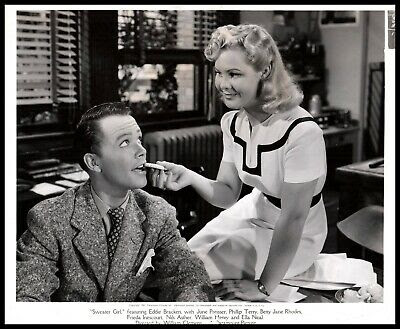
SWEATER GIRL is the perfect B-movie. It has everything: singing, dancing, comedy, romance, mystery, and murder. Not to mention sweaters. The film opens with top-billed Eddie Bracken singing the following lyrics: 

When the sweater girls parade around the campus,

Talk about your heavenly scenes.

Why, they get a better hand than a big brass band,

Or a company of Marines.

I don't want to look at shiny, shiny medals,

Or at twenty-one guns ablaze.

But when the sweater girls parade around the campus,

Mama, give me those, 

Give me those,

Give me those college days!

How's that for subtlety?

Among the attributes already mentioned, the film also contains a little bit of high drama when the mystery is solved and the murderer is revealed. Put all of these components together, and what we have is a thoroughly enjoyable movie experience. 

Bracken plays Jack Mitchell, a student at Midvale College. He and several other students are rehearsing for a musical revue, which is where his opening song is performed. Featured in the revue are acrobatic dancer Susan Lawrence (June Preisser), singer Louise Menard (Betty Jane Rhodes), and songwriter Johnny Arnold (Johnnie Johnston). Susan is romantically interested in Jack and keeps trying to get his attention. The two of them are practicing an adagio number for the revue. Jack, however, is attracted to Louise, who happens to be involved with Susan's older brother, Martin (Phillip Terry), a professor at the college. In the midst of all the rehearsing and romancing, two murders take place, and Jack and Susan team up to solve the mystery.

June Preisser and Eddie Bracken

The film is a wonderful showcase for Eddie Bracken, at the time an increasingly popular contract player at Paramount Pictures. His bubbly co-star, June Preisser, was appearing in one of two films she made at the studio. Miss Preisser had started her film career at MGM, playing opposite Judy Garland and Mickey Rooney in the musical hits BABES IN ARMS (1939) and STRIKE UP THE BAND (1940), but was let go by that studio. Betty Jane Rhodes was a talented, popular singer who made a handful of films for Universal and Paramount. The music in SWEATER GIRL was composed by Jule Styne and Frank Loesser. The film has the distinction of introducing the hit song I Don't Want To Walk Without You, performed by Miss Rhodes. 

Also featured are distinguished stage and film actress Frieda Inescort and Swedish actor Nils Asther. Mr. Asther had been in films since 1916 and was once known as "the male Greta Garbo". He worked with Miss Garbo in the silents WILD ORCHIDS and THE SINGLE STANDARD. Phillip Terry was a hard-working young character actor who is probably best remembered for being married to Joan Crawford from 1942 to 1946. Another familiar face for low-budget movie fans is Minerva Urecal, whose deadpan delivery was a welcome addition to more than two hundred films.

High drama with a low budget. Frieda Inescort and Nils Asther

The main attraction for me is June Preisser. This delightful actress didn't make many films in her brief career, which is a real shame. She was not only gorgeous, but she was a talented acrobat and dancer. She had a signature acrobatic trick that she performed in almost every one of her films. She would fall forward onto her torso, and then sort of roll herself over and upward. In SWEATER GIRL, she gets to strut her stuff beautifully in the adagio dance with Eddie Bracken. After leaving MGM, all of her subsequent films were in the B category. One is especially memorable: MURDER IN THE BLUE ROOM (1944), a comedy/mystery/musical made at Universal, where she is featured in a singing group called The Three Jazzybelles, a takeoff on The Andrews Sisters. Miss Preisser ended up working for Monogram in a series of films featuring characters known as The Teenagers. I've only seen a few of these lively little flicks. Despite their low budgets, they provide good entertainment and good work by Miss Preisser. By the end of the 1940's, she was out of the business. I can understand that she may have been difficult to cast in spite of her talent and good looks. June Preisser never seemed to mature as an actress in the same way as her contemporaries, such as Judy Garland and Deanna Durbin. She always came across as a thirteen-year-old kid with a knowing look on her face, a slightly unsettling combination. She was still cast as a teenager when in her late twenties.

Lovely June Preisser

Eddie Bracken, of course, went on to star in some of the best comedies of the 1940's, including THE MIRACLE OF MORGAN'S CREEK (1944) and HAIL THE CONQUERING HERO (1944), both directed by Preston Sturgess. He would continue working in films and television well into the 1990's. SWEATER GIRLS was directed by William Clemens, who worked primarily as a director, but also as a producer and an editor on mostly second features throughout the 1930's and 40's.


Saturday, March 19, 2022

DIGGING FOR CINEMATIC GOLD AT DOLLAR TREE


For collectors of DVDs and Blu-rays, Dollar Tree has become a popular source for picking up mostly obscure titles as blind buys. Like many of my fellow collectors, I admit to having a serious addiction to wandering into this somewhat quirky retail giant and digging through the boxes of cheap movies that are invariably piled on top of each other. The new supplies usually show up in stores once a month. Anyone who shares this addiction knows that most of the titles turn out to be worth much less than a dollar. But it's also possible to find some very pleasant surprises, and even an occasional classic. Last week I went into one of my four local Dollar Trees for no discernible reason and ended up walking out with a stack of movies. Happens all the time. Clearly an intervention is needed. But this time I picked up some very cool items, along with a couple of duds.

ABSOLUTE BEGINNERS (1986)
Directed by Juno Temple. Starring Eddie O'Connell, Patsy Kensit, David Bowie, James Fox, and Ray Davies.
This is a title I've heard of but had never seen. What a terrific film! It's a highly stylized look at London in the late 1950's when the youth culture was beginning to gain importance. It also deals with some of the racial strife in the city. It's kind of an English WEST SIDE STORY in some ways, but not as dark and dramatic until near the end of the film. It also reminded me of the 2021 English film LAST NIGHT IN SOHO, which showed a dreamlike vision of the London of the 1960's. Lots of good music, some of it written by David Bowie, who is excellent in his supporting role. He's very charismatic when he sings and dances. Too bad he didn't make a lot more films.

BAD INFLUENCE (1990) 
Directed by Curtis Hanson. Starring Rob Lowe and James Spader.

This is a top-notch psychological thriller that managed to escape my radar until now. Spader plays a financial analyst named Michael, an uptight, unassertive guy who finds his life frustrating. He's engaged to a beautiful woman but doesn't seem to love her and can't find the guts to break the engagement. Out of nowhere comes this guy named Alex (Lowe) into his life. He's self-confident, aggressive and energetic, everything Michael isn't. As their friendship grows, and Michael begins following Alex's advice, his life appears to be changing for the better. Then things start to get weird and out of control. When Michael tries to break off the friendship, he learns how dangerous Alex really is. A great film that held my attention throughout. It gets a little bloody toward the end, but there's a lot of genuine excitement as well as good chemistry between the two stars.

DARK ENCOUNTER (2019)
Directed by Carl Strathie. Starring Laura Fraser, Mel Raido, and Sid Phoenix.

A large percentage of the movies that wind up at Dollar Tree are horror and science fiction titles. Some of them turn out to be just OK, and most of them are terrible. DARK ENCOUNTER was another pleasant surprise. I never heard of the director or anyone in the cast, but this is a well-acted, intense little film. The theme is somewhat familiar. A family living in a remote area is suffering because of the mysterious disappearance of their preadolescent daughter one year ago. As they gather with friends and relatives to mark the anniversary of the sad occurrence, some very strange things start happening. They start to find evidence of extraterrestrial involvement. But just when you think you know where the story is leading, it makes a sharp turn into something entirely unexpected. This is an excellent combination of science fiction and heartbreaking human drama. The special effects are well done but are not overdone, thankfully. The best things about the film are the believable dialogue and the interactions between the characters. Recommended.

HECTOR AND THE SEARCH FOR HAPPINESS (2014)
Directed by Peter Chelsom.
Starring Simon Pegg, Toni Collette, Rosamund Pike, and Christopher Plummer.

This is an English film and another one that I'd never heard of. I decided to buy it for the cast of familiar actors. Toni Collette is always worth watching. It turned out to be another very positive experience. Simon Pegg plays Hector, a successful psychiatrist with a lovely live-in girlfriend. He's a man who seemingly has everything. But he becomes frustrated by not being able to provide happiness for his patients and becomes obsessed with trying to define exactly what happiness is. So, he goes off on a quest to find that definition. His search takes him to China, Africa, and eventually to Los Angeles to reunite with an old flame. The action is very funny, although the movie has its darker moments as well. Very enjoyable.

NICHOLAS NICKLEBY (2002)
Directed by Douglas McGrath.
Starring Jamie Bell, Anne Hathaway, Charlie Hunnam, Nathan Lane, and Christopher Plummer.

I've never read the novel by Charles Dickens or seen any other screen adaptations. This is a beautifully filmed, very sensitive movie that certainly qualifies as an important "find" from the bins at Dollar Tree. Jamie Bell plays Nicholas, a young man of modest birth who, upon the death of his father, goes to London with his mother and sister to seek the aid of his uncle, played by Plummer. He finds himself and his family at the mercy of a cold, corrupt, selfish relative. He is sent away to teach at a remote school for boys and learns the meaning of cruelty. Escaping from that situation, Nicholas eventually finds his way to having control over his life and coming to the aid of his mother and sister. Gorgeous English locations and excellent performances, especially by Mr. Plummer, make this a rewarding watch.

ONE MAN'S HERO (1998)
Directed by Lance Hool.
Starring Tom Berenger and Patrick Bergin.

This beautifully photographed film is trying hard to be an epic, and almost succeeds. Based on a true story, it tells of the St. Patrick Brigade, a group of Irish soldiers who end up fighting for Mexico during the Mexican-American War. These immigrants had been promised American citizenship if they joined the U.S. Army. But they find them selves suffering cruel discrimination for their Catholic beliefs. After Seargent John Riley (Berenger) leads them to freedom across the Mexican border, they agree to take up arms against the Americans, risking their lives if caught and tried for treason. The film is very straightforward in its approach and filled with exciting action sequences. Tom Berenger gives one of the best performances of his career.

AUTUMN IN NEW YORK (2000)
Directed by Joan Chen.
Starring Richard Gere, Winona Ryder, and Elaine Stritch.

These last two films were much less satisfying. AUTUMN IN NEW YORK gives us an unlikely romance between an older man and a much younger woman. Nothing terribly original there. But it gets even worse. The man, played by Gere, is a successful restaurant owner and a career womanizer. The young woman in the equation is waif-like Winona Ryder, who we soon learn only has a short time to live. And there you have it. Will the womanizing Gere, whose good looks and cheeky grin have gotten him any woman he's ever wanted, fall deeply in love with vapid twenty-something Ryder and do whatever he can to save her life? You betcha. The problem I had with this movie, besides the cliche-ridden plot, is my dislike of Winona Ryder. Nothing personal, but the woman can't act. The film wants us to be overwhelmed with emotion every time the camera moves in for a closeup of her blank face. Sorry, Winona. It's just not happening for me. The film does have gorgeous New York City locations. And Richard Gere and Elaine Stritch are always good to watch. Beyond that, very little is memorable.

MARY (2019)
Directed by Michael Goi.
Starring Gary Oldman and Emily Mortimer.

And now for the worst of the lot. This is a by-the-numbers horror flick that has all the originality of a Bowery Boys quickie in the late 1950's. It has the standard plotline of a family (husband, wife, two adorable daughters) finding themselves trapped in a dark, frightening dwelling inhabited by evil spirits. The only detail that's different from most such horror films is that the dwelling isn't an old, creepy house. Instead, it's an old, creepy boat. So, Mr. Goldman buys himself a boat to start a business and takes his family along on the initial voyage. Terrible things begin to happen. Turns out this boat has quite the macabre history. But, naturally, the folks find this out way too late, when they and the malevolent boat are stuck out in the middle of nowhere. The movie has the required number of jump scares to please the adrenaline junkies. And the cinematography is quite good. Beyond that, forget it. 

And there you have the results of my latest adventure at Dollar Tree. If any of these titles interest you, I'm sure you'll be able to find them buried in the boxes at your local store. However, be forewarned. Their basic price has gone from $1.00 to $1.25. That might make you a little more discriminating.


Sunday, March 6, 2022

TIM CONSIDINE (1940-2022)

It's hard to say goodbye to old friends and childhood heroes, even if you've never actually met them. Friends we know through books, films, and TV shows can have as much meaning in our lives as the kid who grew up next door.

A former actor named Tim Considine passed away a few days ago at the age of 81. Young people will probably have no idea who he was, which is understandable. But for my generation, the baby boom types who grew up during the early days of television, the 1950's, Tim was a familiar face, an important part of our collective memory. 

He was born into a show business family. His father was a film producer, and his maternal grandfather was theater magnate Alexander Pantages. Tim began his acting career in the 1953 Red Skelton film THE CLOWN. He only made a handful of films in his career and was best known for his work in television. In 1955, Tim was one of the stars of the serial THE ADVENTURES OF SPIN AND MARTY, which was featured on the hit kid's show THE MICKEY MOUSE CLUB. The serial was about a group of adolescent boys from different backgrounds who spend the summer on a ranch called the Triple R. It was sort of like the ultimate summer camp experience, with the boys getting to ride horses, sing around a campfire every night, and take part in a rodeo. Tim played Spin Evans. He was from a working-class family and was the most popular guy at the ranch, the super-cool kid that we all wished we could be. The other star of the show was David Stollery, who played Martin "Marty" Markham. He was a rich boy from the city who grew up without a mother and father, and instead was raised by his old, very conservative grandmother. Marty has spent little time with boys his own age and is used to a life of privilege, which makes it difficult to fit in with the other boys. He and Spin lock horns in the early episodes. But as the story unfolds, and Marty learns how to get along with the others, he and Spin end up being best friends. 

David Stollery and Tim Considine

The serial was so popular that it was continued for the second and third seasons of THE MICKEY MOUSE CUB. As the boys were growing and developing along with all of the kids who were watching, their life experiences began including girls, specifically Annette Funicello and Darlene Gillespie, two prominent Mouseketeers. It was all very innocent, as you would expect from Walt Disney. These shows were certainly reflective of another time and place. Maybe even another planet! And yet, I think even the kids of today would be able to respond to the situations these characters were going through. The show has much to say about fair play and learning how to get along with others. It also wasn't afraid to show the boys crying because they were homesick or worried about not fitting in. But the most important thing we all learned from spending our afternoons with Spin and Marty was about friendship. And in their real lives, Tim Considine and David Stollery would be lifelong friends.

Tim continued working for Walt Disney for a number of years. He was featured in two other popular serials that played on THE MICKEY MOUSE CLUB. First, there was THE HARDY BOYS, also starring Tommy Kirk, another popular Disney star who sadly passed away last year. Then Tim was featured in the serial ANNETTE, made to capitalize on the growing popularity of Annette Funicello. Tim also was cast in a Disney series called THE SWAMP FOX in 1959. This is one I don't remember seeing. He was also in the hit movie THE SHAGGY DOG (1959). After leaving Disney, he was in the hit television show MY THREE SONS from 1960-1965. After that, his life as an actor began slowing down, by his own choice. He continued to act occasionally, but also worked as a writer and director for television. He turned up in a small but memorable bit part in   PATTON (1970). He played a shell-shocked soldier who is slapped and branded as a coward by General Patton. Tim's fans were quite surprised and impressed to see him in this very emotional performance.

Tim's career path eventually went in the direction of writing and photography. He authored several books about sports, primarily motor sports. (One of his projects involved David Stollery, who had left acting behind in his teens and went on to be a successful automobile designer. He was responsible for the design of the Toyota Celica A40 Series in 1978.) One of Tim's well-known photographs is the cover of the Joni Mitchell album BLUE in 1971.


Tim Considine and David Stollery reunited for a reboot of SPIN AND MARTY in 2000. And they were together again in a documentary about the show when the original 1955-56 serial was released on DVD in 2005. Both men were respectful about the enduring interest in the show and what it meant to the fans who grew up watching it.


The last time I saw the two old friends together was a few years ago when a sound stage on the Disney lot was renamed in honor of Annette Funicello. It was great to see them again. David Stollery, God bless him, is still with us. But we no longer have Tim in this world. As I said at the beginning of this article, it's tough to lose these iconic figures who have served as cultural touchstones over the years. There's a quote from Uncle Walt Disney himself, included on the flyer from the Disney Treasures release of SPIN AND MARTY, that nails it perfectly:

"I love the nostalgic, myself. I hope we never lose some of the things of the past."

Thanks, Uncle Walt.

So long, Spin.


Thursday, February 24, 2022

THE WOODY ALLEN COLLECTION


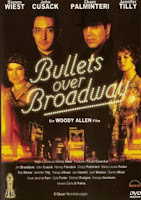
This box set of eight Blu-ray releases of films directed by Woody Allen between 1994 and 2003 is a welcome addition to my collection. I'm a big fan of Woody's films and own most of them on DVD. This release gave me a chance to fill in a few gaps in what I previously haven't been able to find. The package was released by Quiver Films on November 23, 2021.


The transfer quality is excellent. However, there are no extras on any of the Blu-rays. Not even theatrical trailers. This is somewhat disappointing, but not surprising. My DVDs of Woody's films don't have any extras beside the occasional trailer. This is one director who will most likely never do any audio commentaries on his movies. The discs do include the scene selection feature, something that quite a few new releases, including many from Kino-Lorber, don't have. The outer case is solidly made, and the inner case has nice still photographs from some of the films.


THE FILMS

BULLETS OVER BROADWAY (1994) 
Starring John Cusack, Dianne Wiest, Jennifer Tilly, Chaz Palminteri, and Tracey Ullman. This is one of the films I hadn't seen before. Pure movie magic. One of Woody's very best. Cusack plays ambitious young playwright David Shayne, who uses mob money to get his first Broadway play produced in 1928. The catch is that he must cast the mobster's talentless girlfriend and also put up with her assigned bodyguard. The bodyguard begins offering ideas for the play, and they work so well that the play becomes his creation more than Shayne's. This film was a huge success and won several awards and other nominations. Dianne Wiest won her second Oscar for Best Supporting Actress. She had won previously for another Woody Allen film, HANNAH AND HER SISTERS (1986). 

MIGHTY APHRODITE (1995)
Starring Woody Allen, Mira Sorvino, Helena Bonham Carter, Michael Rapaport, F. Murray Abraham, and Olympia Dukakis. Another very funny, well-written film. Woody plays Lenny Weinrib. He and his wife adopt a son, and Lenny becomes obsessed with finding the boy's real mother. She turns out to be a ditzy but good-hearted prostitute whom Lenny falls in love with. This film was also nominated for many awards. Mira Sorvino won the Oscar for Best Supporting Actress as the prostitute.

EVERYONE SAYS I LOVE YOU (1996)
Starring Woody Allen, Goldie Hawn, Alan Alda, Edward Norton, Julia Roberts, and Drew Barrymore. The lives and loves, trials and tribulations, of an upper middle-class New York family are played out with everyone in the movie breaking out into singing and dancing to old romantic standards. Incessantly. This is the film I was most excited about seeing again, as I loved it when it was first playing in theaters. But it turned out to be disappointing upon second watch. It's loaded with big stars but spends too much time with some uninteresting teenagers who manage to become irritating very quickly. It was not a box office success. 

CELEBRITY (1998)
Starring Kenneth Branagh, Judy Davis, Leonardo di Caprio, Winona Ryder, Melanie Griffith, and Charlize Theron. Woody makes a welcome return to Black & White cinematography with this very eccentric movie. Branagh, a writer, gets divorced from his wife, Davis, an English teacher. They both find success and loads of drama by finding careers in celebrity journalism. A fascinating film to watch, although not one of Woody's best screenplays. It was another box office failure.

SMALL TIME CROOKS (2000)
Starring Woody Allen, Tracey Ullman, Hugh Grant, Elaine May, George Grizzard, and Elaine Stritch. Woody returns to top form with this very funny story about the most insane idea for a bank robbery ever conceived. Loaded with great dialogue and sight gags. This one did well at the box office.

THE CURSE OF THE JADE SCORPION (2001) Starring Woody Allen, Helen Hunt, Dan Akroyd, David Ogden Stiers, Wallace Shawn, Charlize Theron, and Elizabeth Berkley. Another movie I hadn't seen before. Woody plays an insurance investigator who gets into conflict with efficiency expert Helen Hunt, and the two dislike each other intensely. One night, while in a nightclub for an employee dinner, the two are called to take part in a stage act by hypnotist Voltan (Stiers). He gives each of them post-hypnotic trigger words to use them for jewel robberies. This was Woody's most expensive film to date, and it lost money. Woody considered it to be his worst film and said he should have gotten another actor to play his part. Personally, I loved the film. But what do I know?

HOLLYWOOD ENDING (2002)
Starring Woody Allen, Tea Leoni, George Hamilton, Treat Williams, Mark Rydell, and Debra Messing. This is another one of Woody's less successful movies that I nonetheless loved. In this one, he plays an anxiety-ridden filmmaker desperate for a comeback. He gets his big chance when his ex-wife (Leoni) and her boyfriend (Willaims) hire him to direct a big-budget blockbuster. Unfortunately, he develops psychosomatic blindness when the project starts. he tries to direct the movie without anyone knowing that he can't see a thing. Lots of great dialogue and sight (no pun intended) gags throughout.

ANYTHING ELSE (2003)
Starring Woody Allen, Jason Biggs, Christina Ricci, Stockard Channing, Danny DeVito, and Jimmy Fallon. This box set ends on a sour note with one of my least favorite of all the Allen films. Woody plays struggling artist David Dobel, who acts as a mentor to aspiring writer Jerry Falk (Biggs), coaching the younger man through his trials with love and relationships. Biggs is irritating beyond belief as he attempts to do a Woody Allen imitation throughout the entire movie. The characters are all unlikable and the situations and dialogue seem like they are parodied from other Allen films. Another failure at the box office. A real shame, considering that it featured Ricci, a talented and often poorly used actress. Stockard Channing is so bad, it's almost painful to watch her.


Tuesday, February 22, 2022

MONDO CANE (1962)


MONDO CANE (Dog World or Doggish World) is a notorious, groundbreaking documentary showing bizarre examples of human and animal behavior in various locations and societies of the world, the Western world included. Featured are mating practices among the natives of New Guinea, religious rituals involving snake handling and self-flagellation among Italian Catholics, and segments showing cruelty to animals which are very difficult to watch. 

Some of the segments are lighthearted and amusing. For example, there is an extended look at a group of elderly American tourists in Hawaii trying their best to learn how to dance the Hula. And there is a look inside a sophisticated New York restaurant where a number of very chic individuals are eating cooked insects and appear to be thoroughly enjoying themselves. The film takes a much darker turn with a look at several Germans staggering around the streets after a night of excessive drinking. And then, we are off to a village in Portugal, showing a yearly event where men try not to be killed when wild bulls are let loose in the town square. The film is making the point that so-called "civilized" Westerners haven't advanced all that much than the people of more remote cultures.

One of the saddest segments shows the effects of nuclear testing by the United States on the environment of the Bikini Atoll. The camera follows sea turtles going on to the land to lay their eggs. However, they are no longer able to find their way back to the sea and instead travel further inland where they will die. The film shows the beaches littered with their decaying skeletons. So much for the advancement of civilization.

These dark and sometimes grotesque are made all the more shocking by being interspersed among the lighter, more amusing parts. Then there is the beautiful music score composed by Ritz Ortolani and Nino Oliviero. It is so lovely that it almost seems inappropriate for such a strange and visceral film. The main theme became world-famous as the song "More". Romantic English lyrics were written for it by Norman Newell, and it was nominated for the Academy Award for Best Original Song.

MONDO CANE is essential viewing for any student of film history, and for anyone interested in world cultures. Be forewarned, however. There are some instances of cruelty to animals that may be disturbing to many viewers, especially children. The film was written and directed by Paolo Cavara, Franco Prosperi, and Gualtiero Jacopetti. The film's title is sometimes translated as A DOG'S LIFE.


SWING HOSTESS (1944)


This is the kind of bright, funny, fast-moving movie musical I fell in love with during countless afternoons watching the "early show" after school in the 1960's. The rather thin plot has singer Judy Alvin (Martha Tilton) trying to break into the music business. She has real talent and gets a chance to make a record. However, because of a series of blunders and misunderstandings, a decidedly untalented rival, Phoebe Forbes (Betty Brodel), gets the credit for Judy's vocals and is signed to a record contract. Judy and Phoebe both live at the same theatrical boarding house. The other tenants, led by Judy's best friend, Marge O'Day (Iris Adrian), join forces to get Judy the recognition she deserves. All ends well at a swank nightclub where Judy gets to sing and becomes a star, not to mention winning the heart of handsome band leader Benny Jackson (Charles Collins).

This 76-minute gem was directed by Sam Newfield for Producers Releasing Corporation (PRC), one of the most prolific "poverty row" studios of the period. The energetic cast was headed by Miss Tilton, an extremely gifted singer who was quite popular during the WW2 years. SWING HOSTESS gives her the opportunity to perform no less than six songs written by Jay Livingston, Ray Evans, and Lewis Bellin.

Miss Tilton is ably supported by Iris Adrian, the undisputed Queen of the fast-talking, wisecracking dames in countless movies of the 1930's-1960's. There were few actresses in movie history who were as adept at tossing off one-liner insults and zingers as Miss Adrian. Seeing her name in a cast list is always a guarantee of a good time.

Martha Tilton and Iris Adrian

The film also serves as an interesting time capsule. Part of the story has Judy working for a "telephone juke box" company. A Rock-ola juke box in a diner has a list of songs and a telephone number. Customers wishing to hear a song call the company's central location where an actual record will be played and heard over loudspeakers in the diner. I never even knew this type of juke box existed!

SWING HOSTESS may not have the same star power or production values of the big budget musicals of 1944, but it does have good music and a lot of heart. Consider it 76 minutes of your life put to good use.